[Case Study] 1 Barista, 8-Pyeong Store. Blank Street Coffee's Automation Blueprint.
[Case Study] 1 Barista, 8-Pyeong Store. Blank Street Coffee's Automation Blueprint.
Insights
Insights
Insights
|
|
1. A Brand That Started with a Single Battery-Powered Cart
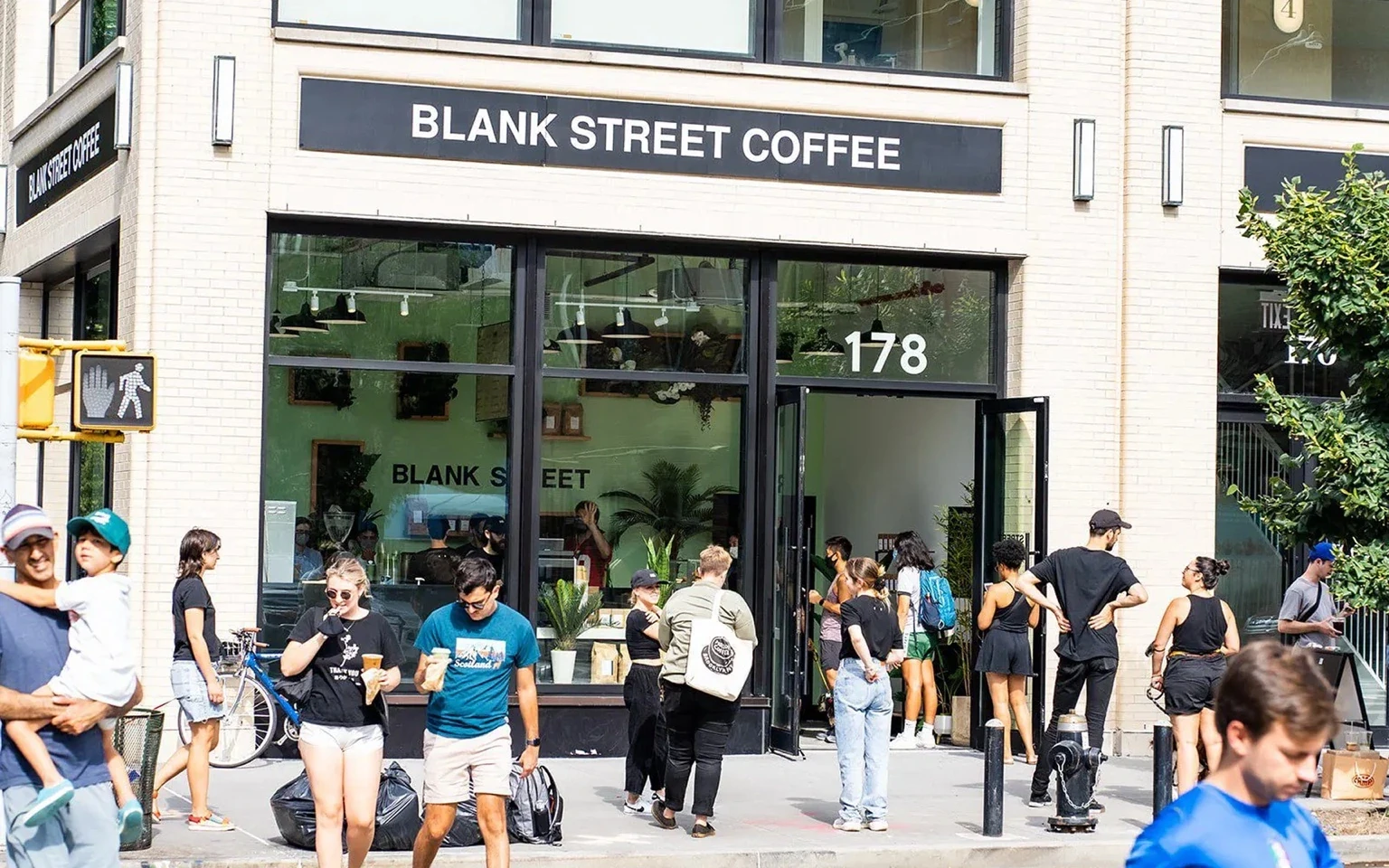
May 2020, Williamsburg, Brooklyn, New York. Vinay Menda and Issam Freiha, who were in the venture capital industry, started a business with a single battery-powered mobile coffee cart. They revealed that they thought "this is it" after seeing ultra-small, mobile retail models in Asia, such as Kopi Kenangan in Indonesia and Heytea in China.
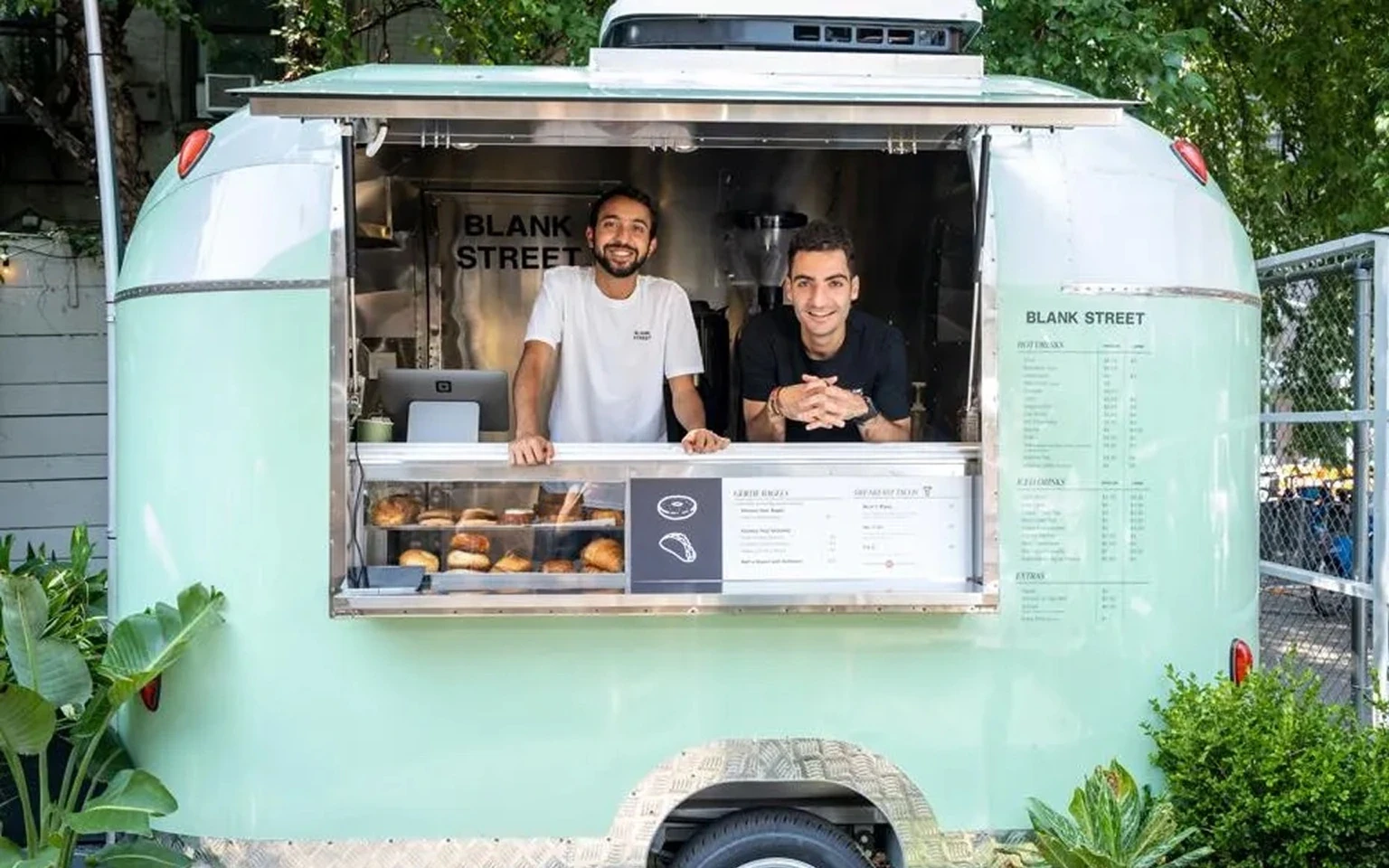
(Source: Greenprophe)
And five years later, Blank Street has grown into a brand operating more than 90 stores across New York, London, Bristol, Birmingham, Manchester, Edinburgh, Glasgow, Boston, and Washington, D.C. As of July 2025, its corporate value is approximately $500 million. In April 2026, the Financial Times reported news of the brand attracting over $100 million in new investment, which could bring its valuation close to $1 billion.
This brand grew by radically downsizing its stores and has recently met its second growth momentum. Let's break down its growth story.

2. Fully Automatic Machines: The Core Driver of the Brand
The most common keyword when talking about Blank Street is 'small stores'. But how was that small store possible, and how was it operated? The brand pointed to fully automatic coffee machines as a key factor.
According to what Jai Lott, VP of Operations at Blank Street, said in an interview with Global Coffee Report, they introduced 25 Cameo models from Swiss brand Eversys during the early mobile cart stage. Later, as they expanded into brick-and-mortar stores, they introduced 5 Shotmaster models (2-group, including steam wands) capable of high-volume processing. They operated by swapping out the equipment lineup itself depending on the business phase.
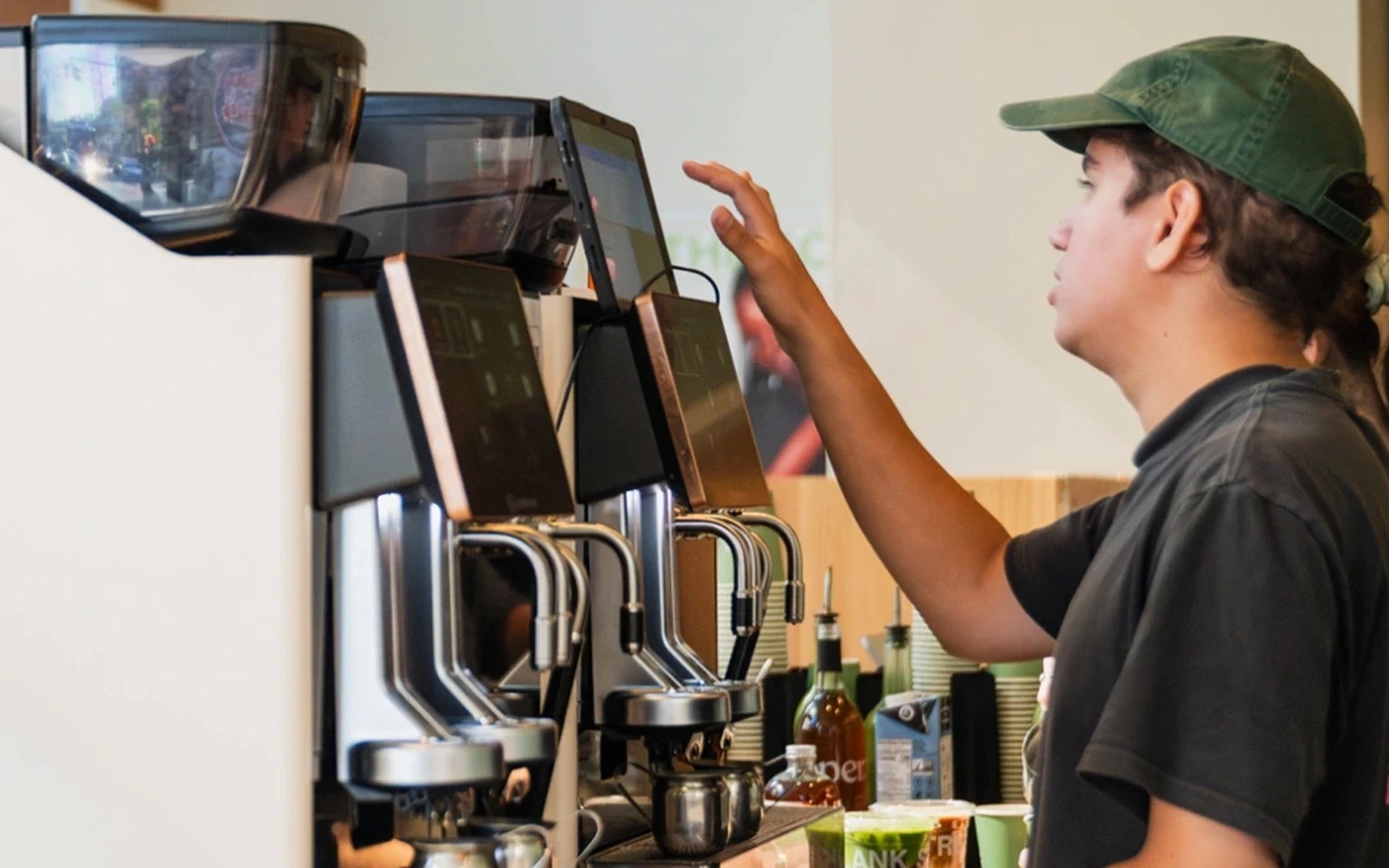
(Source: Eversys)
Lott said, "We demand a lot for our espresso recipe. 20g of coffee grounds in, 40g yield, 35-second extraction time. The Shotmaster needs to grind finely to meet this. Once you input the recipe, after that, you just need to press a single button." He also mentioned that it no longer makes sense to teach baristas manual processes like grinding or tamping. Instead, the training method itself has changed to explaining the extraction principles and teaching which button leads to which action.
Using this machine, the entire process—including grinding, dosing, tamping, extraction, milk steaming, and cleaning—is processed automatically, pulling up to 700 cups of espresso per hour with an 8-product simultaneous production system. It also features a compact footprint that can fit onto narrow counters.
Lott also explained the reason for introducing fully automatic machines in clear financial terms: "The return on investment (ROI) is higher than that of traditional machines. It allows us to maintain our core value proposition of speed, service quality, and taste even as we rapidly expand across the US."
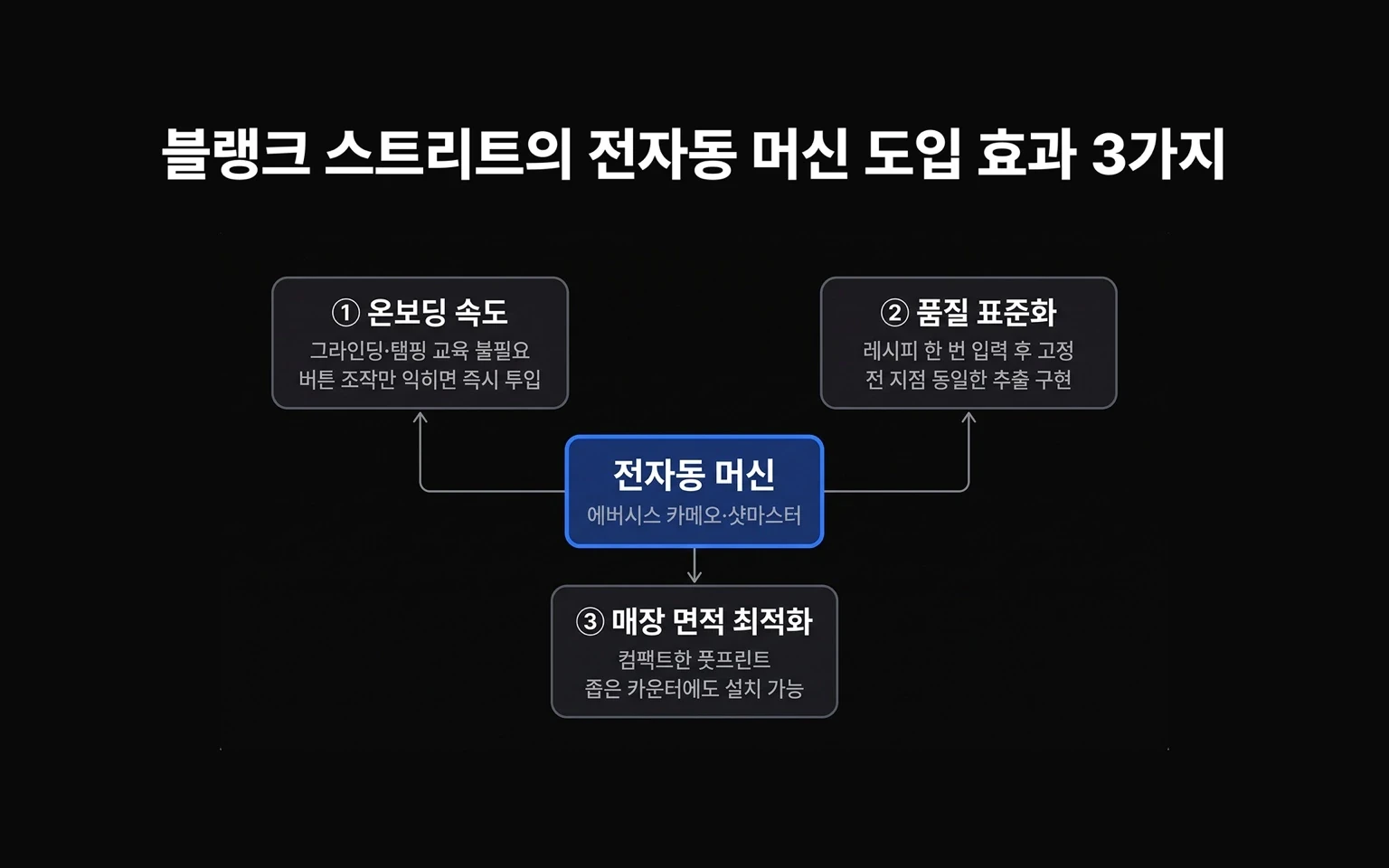
The point to note here is that the introduction of fully automatic machines did not end with the single goal of saving labor costs. The key is that it was a means to solve three problems simultaneously: ① the speed of onboarding new baristas, ② quality standardization during multi-store expansion, and ③ store space optimization. Keeping the stores small and reducing staff was ultimately a result made possible because this equipment guaranteed extraction without relying on human skill levels.
3. The Leeway Gained from Automation Led to the Success of Other Menu Items
As the fully automatic machines reduced human intervention in the brewing process, the organization gained the leeway to use that much manpower and resources elsewhere. While one area where that resource went was logistics (central kitchen and same-day delivery to local hubs) and food menu outsourcing (partnerships with Parlor Coffee, King David Tacos, and Milk Bar), another was in-house beverage development.
(Source: Blank Street Coffee)
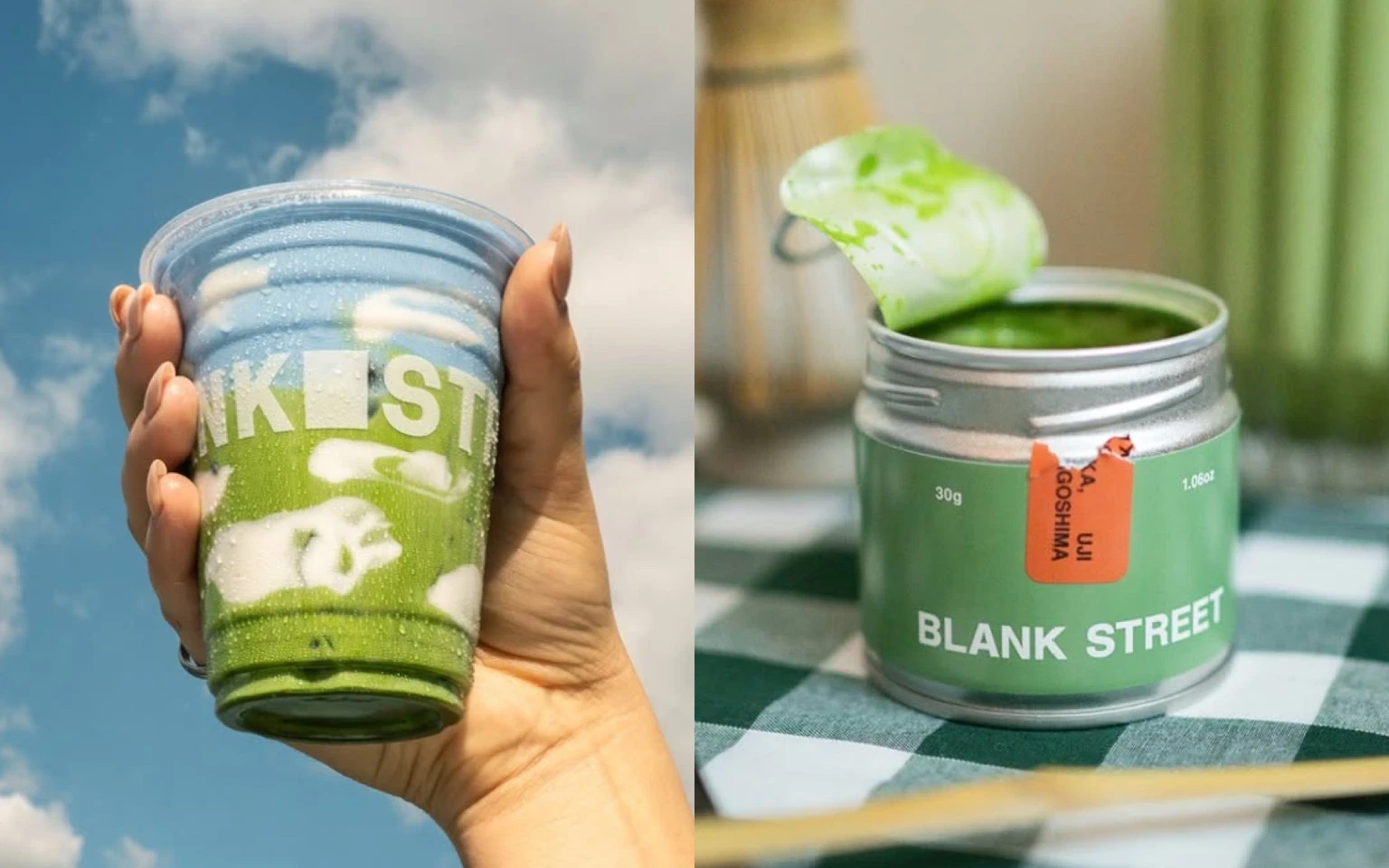
Matcha is a prime example. According to co-founder Vinay Menda, a Blueberry Matcha created by a beverage developer on the London team went unexpectedly viral on social media, prompting the company to inject resources into matcha development in earnest. Ignacio Llado, the UK Managing Director, also stated in an industry media interview that "Blueberry Matcha went viral on TikTok and through word-of-mouth in the spring of 2023, quickly becoming a bestseller." Since then, they have developed and released highly colorful new seasonal menu items, such as Strawberry Shortcake Matcha and Cookies & Cream Matcha. Menda directly stated that as of 2025, matcha accounts for about 50% of total sales. That is why the matcha menu exists as a major category alongside coffee and non-coffee on Blank Street Coffee's cafe menu board.
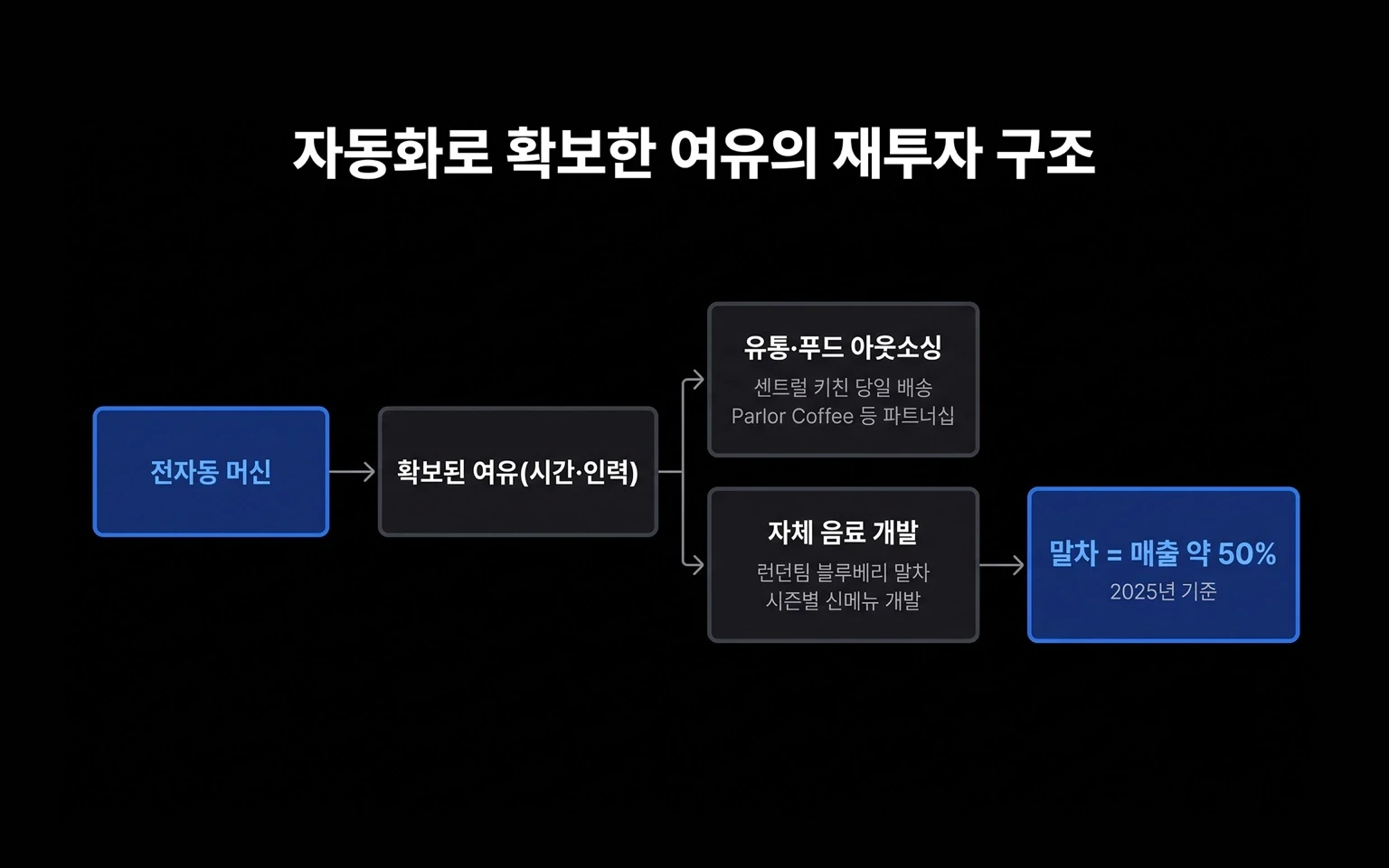
In short, they outsourced food and focused internal resources on drink development. Ultimately, what the fully automatic machines created was not just fast extraction, but the freedom that came from people not having to cling to the extraction process, and where to reinvest that freedom was the new turning point for the brand's growth—this is the core of this case study.
4. Lock-in Designed with a Subscription Model
The subscription service 'Blank Street Regulars', which launched in the US in September 2023, is an example demonstrating data-driven operation. It initially started with a weekly plan of $8.99 to $17.99, but after adjustments, it is currently operated under a structure where users can enjoy up to 14 cups (with a 2-hour interval limit) for $22 per week. In the UK, it is operated separately with a weekly plan of £12 (about $15).
Blank Street's beverage prices average around $7 to $8 (standard latte is $6.75, signature matchas are $7.4 to $8.7). Being able to use up to 14 cups for $22 a week means about a 75-80% discount compared to the regular price if you drink them all. To put it extremely, it is a structure where you already get your money's worth by drinking just 3 cups a week.
(Source: Global Coffee Report)
However, the real reason lies in behavioral design rather than the discount rate. Thanks to the 2-hour repurchase interval limit, instead of "chugging them all at once and being done," a habit of visiting multiple times a day was formed. Once paid, the sunk-cost fallacy of "it's a waste if I don't use it" drives repeat visits. On top of this, they added scarcity by intentionally limiting the number of subscribers from the early launch stage, building up a waiting list of 4,000 people. Combining these three factors pulled up the actual visit frequency. Co-founder Vinay Menda stated, "Customers originally visited 2 to 3 times a week, but after the subscription program, it increased to up to 6 times a week."
Taking the MoviePass case—which went bankrupt due to unlimited subscriptions—as a lesson, they set a cap. Thanks to this, they built a structure where subscription sales became "pre-paid, guaranteed revenue" rather than a "discount." Within four months of launch, they gathered about 5,000 paid subscribers, and Menda stated that they expect 30-40% of all customers to convert to subscribers in the long run.
5. Blank Street's Second Act
Blank Street also recently announced a change in strategy. They are looking at a second strategy of increasing the size of their stores. This is drawing a lot of attention because it goes in the opposite direction of their success formula.
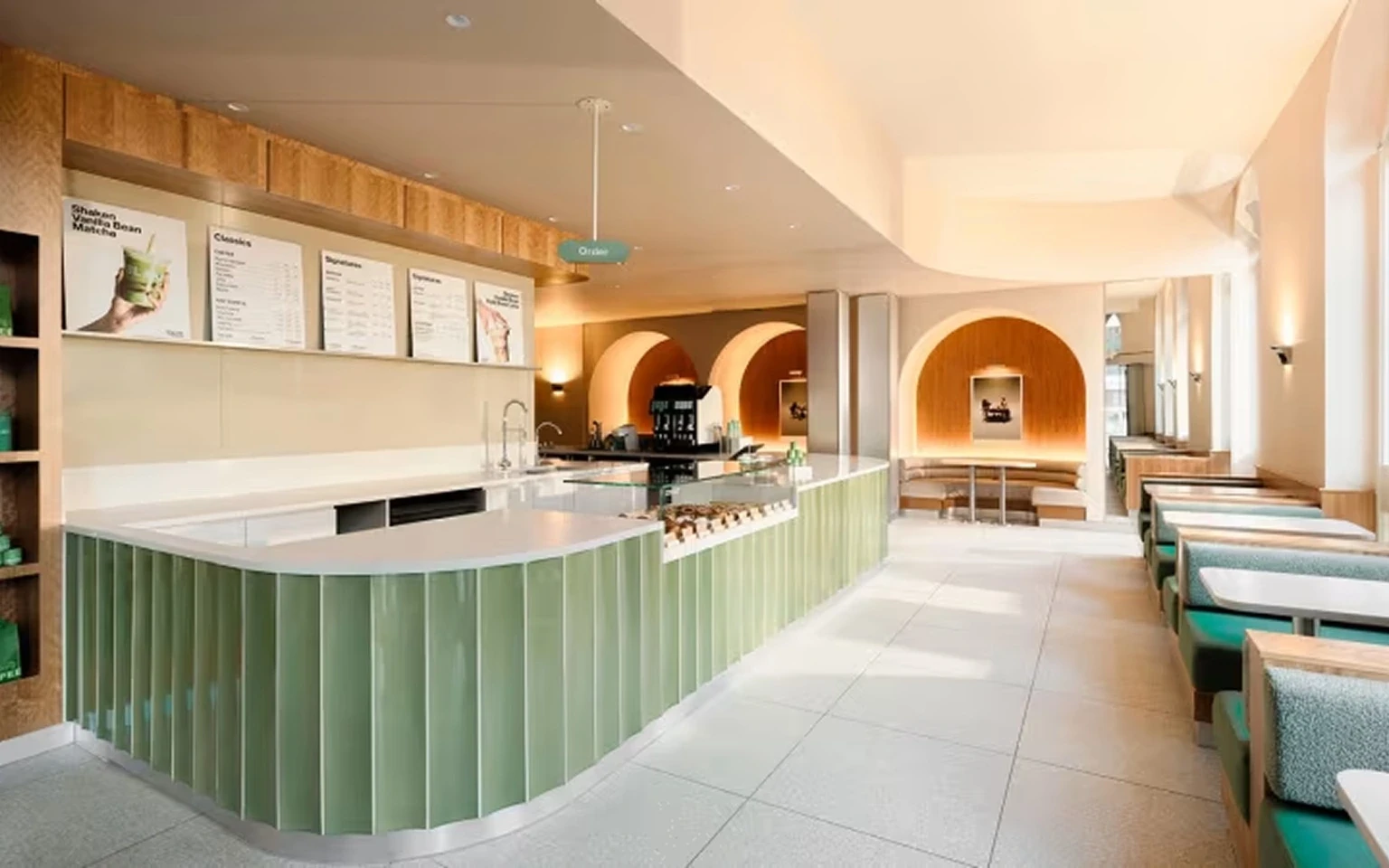
In 2025, US sales grew 21% year-on-year, but slowed down compared to before (based on Bloomberg Second Measure). The new stores are three times the size of existing seating-less stores (around 1,300 square feet), featuring large mirrors, lighting, and even a waiting area. Regarding the new store on the University of Pennsylvania campus in Philadelphia, Menda stated, "At this scale, we can invest deeply in design and offer an elevated hospitality experience."
(Source: Blank Street Coffee)
However, there is also plenty of criticism. The existing model was a break-even structure where, with an average of 500 square feet, a monthly rent of about $3,500 in New York (compared to $10,000 to $15,000 for regular cafes), and 1 to 2 staff members, they could match the profitability per square foot by making only about 27% of Starbucks' revenue. This advantage was the key logic that attracted investors. The point of criticism is that if the stores get bigger, rent, staffing, and operational complexity will increase together, potentially shaking this very structure.
Blank Street achieved great growth with its high-efficiency strategy, and now they are trying to solve its growth slowdown phase with a different strategy. We should watch whether their existing operational experience and new hospitality strategy can create positive synergy. The performance of the new LA and Philadelphia stores in the second half of 2026, along with whether the discussed investment of over $100 million is finalized, will likely serve as indicators to gauge the success of this experiment.
Closing Thoughts
The situation for domestic cafes and bakeries is not much different. The pressures of labor shortages, rising labor costs, and managing quality deviation across stores exist in the same way. It is in the same context that half of the top domestic franchises have recently fully or partially introduced fully automatic machines.
The case of Blank Street also aligns with the development background of Aware. Easily deploying the golden recipe configured by headquarters to all branches through Aware, and maintaining quality based on cloud data. This goes beyond simple manufacturing automation; it is to guarantee 'consistency', an important goal that fully automatic machines must achieve for cafe brands. And the leeway in labor and time naturally secured in this process leads to peak profitability, just as it did for Blank Street. In the end, the background that allowed a brand starting from a single battery cart to become a $500 million company was this virtuous cycle of automation.
References:
Consumer Edge, "Blank Street in talks to raise $100mn amid rising spend from younger consumers" (2026.4.7)
Global Coffee Report, "Eversys on the advantages of automation" (Interview with Jai Lott)
Eversys Official Website, Shotmaster Product Specifications
CoffeeTalk, "Building A $500 Million Coffee Chain By Selling TikTok Drinks To Teens" (2025.6.25, Interview with Vinay Menda)
Tea & Coffee Trade Journal, "Ceremonial to TikTok Trending: The Evolution of Matcha" (2024.10.29, Interview with Ignacio Llado)
CNBC, "Blank Street Coffee bets on subscription program" (2024.1.5)
Bloomberg, "Blank Street Bets on Bigger Stores, Matcha Drinks to Become Gen Z Starbucks" (2026.3.17)
Aletheuein, "From a Brooklyn Coffee Cart to a Billion-Dollar Cup" (2026.4.7)
The Daily Pennsylvanian, "Blank Street Coffee to open first location in Philadelphia on Penn's campus" (2026.3.5)
1. A Brand That Started with a Single Battery-Powered Cart
May 2020, Williamsburg, Brooklyn, New York. Vinay Menda and Issam Freiha, who were in the venture capital industry, started a business with a single battery-powered mobile coffee cart. They revealed that they thought "this is it" after seeing ultra-small, mobile retail models in Asia, such as Kopi Kenangan in Indonesia and Heytea in China.
(Source: Greenprophe)
And five years later, Blank Street has grown into a brand operating more than 90 stores across New York, London, Bristol, Birmingham, Manchester, Edinburgh, Glasgow, Boston, and Washington, D.C. As of July 2025, its corporate value is approximately $500 million. In April 2026, the Financial Times reported news of the brand attracting over $100 million in new investment, which could bring its valuation close to $1 billion.
This brand grew by radically downsizing its stores and has recently met its second growth momentum. Let's break down its growth story.
2. Fully Automatic Machines: The Core Driver of the Brand
The most common keyword when talking about Blank Street is 'small stores'. But how was that small store possible, and how was it operated? The brand pointed to fully automatic coffee machines as a key factor.
According to what Jai Lott, VP of Operations at Blank Street, said in an interview with Global Coffee Report, they introduced 25 Cameo models from Swiss brand Eversys during the early mobile cart stage. Later, as they expanded into brick-and-mortar stores, they introduced 5 Shotmaster models (2-group, including steam wands) capable of high-volume processing. They operated by swapping out the equipment lineup itself depending on the business phase.
(Source: Eversys)
Lott said, "We demand a lot for our espresso recipe. 20g of coffee grounds in, 40g yield, 35-second extraction time. The Shotmaster needs to grind finely to meet this. Once you input the recipe, after that, you just need to press a single button." He also mentioned that it no longer makes sense to teach baristas manual processes like grinding or tamping. Instead, the training method itself has changed to explaining the extraction principles and teaching which button leads to which action.
Using this machine, the entire process—including grinding, dosing, tamping, extraction, milk steaming, and cleaning—is processed automatically, pulling up to 700 cups of espresso per hour with an 8-product simultaneous production system. It also features a compact footprint that can fit onto narrow counters.
Lott also explained the reason for introducing fully automatic machines in clear financial terms: "The return on investment (ROI) is higher than that of traditional machines. It allows us to maintain our core value proposition of speed, service quality, and taste even as we rapidly expand across the US."
The point to note here is that the introduction of fully automatic machines did not end with the single goal of saving labor costs. The key is that it was a means to solve three problems simultaneously: ① the speed of onboarding new baristas, ② quality standardization during multi-store expansion, and ③ store space optimization. Keeping the stores small and reducing staff was ultimately a result made possible because this equipment guaranteed extraction without relying on human skill levels.
3. The Leeway Gained from Automation Led to the Success of Other Menu Items
As the fully automatic machines reduced human intervention in the brewing process, the organization gained the leeway to use that much manpower and resources elsewhere. While one area where that resource went was logistics (central kitchen and same-day delivery to local hubs) and food menu outsourcing (partnerships with Parlor Coffee, King David Tacos, and Milk Bar), another was in-house beverage development.
(Source: Blank Street Coffee)
Matcha is a prime example. According to co-founder Vinay Menda, a Blueberry Matcha created by a beverage developer on the London team went unexpectedly viral on social media, prompting the company to inject resources into matcha development in earnest. Ignacio Llado, the UK Managing Director, also stated in an industry media interview that "Blueberry Matcha went viral on TikTok and through word-of-mouth in the spring of 2023, quickly becoming a bestseller." Since then, they have developed and released highly colorful new seasonal menu items, such as Strawberry Shortcake Matcha and Cookies & Cream Matcha. Menda directly stated that as of 2025, matcha accounts for about 50% of total sales. That is why the matcha menu exists as a major category alongside coffee and non-coffee on Blank Street Coffee's cafe menu board.
In short, they outsourced food and focused internal resources on drink development. Ultimately, what the fully automatic machines created was not just fast extraction, but the freedom that came from people not having to cling to the extraction process, and where to reinvest that freedom was the new turning point for the brand's growth—this is the core of this case study.
4. Lock-in Designed with a Subscription Model
The subscription service 'Blank Street Regulars', which launched in the US in September 2023, is an example demonstrating data-driven operation. It initially started with a weekly plan of $8.99 to $17.99, but after adjustments, it is currently operated under a structure where users can enjoy up to 14 cups (with a 2-hour interval limit) for $22 per week. In the UK, it is operated separately with a weekly plan of £12 (about $15).
Blank Street's beverage prices average around $7 to $8 (standard latte is $6.75, signature matchas are $7.4 to $8.7). Being able to use up to 14 cups for $22 a week means about a 75-80% discount compared to the regular price if you drink them all. To put it extremely, it is a structure where you already get your money's worth by drinking just 3 cups a week.
(Source: Global Coffee Report)
However, the real reason lies in behavioral design rather than the discount rate. Thanks to the 2-hour repurchase interval limit, instead of "chugging them all at once and being done," a habit of visiting multiple times a day was formed. Once paid, the sunk-cost fallacy of "it's a waste if I don't use it" drives repeat visits. On top of this, they added scarcity by intentionally limiting the number of subscribers from the early launch stage, building up a waiting list of 4,000 people. Combining these three factors pulled up the actual visit frequency. Co-founder Vinay Menda stated, "Customers originally visited 2 to 3 times a week, but after the subscription program, it increased to up to 6 times a week."
Taking the MoviePass case—which went bankrupt due to unlimited subscriptions—as a lesson, they set a cap. Thanks to this, they built a structure where subscription sales became "pre-paid, guaranteed revenue" rather than a "discount." Within four months of launch, they gathered about 5,000 paid subscribers, and Menda stated that they expect 30-40% of all customers to convert to subscribers in the long run.
5. Blank Street's Second Act
Blank Street also recently announced a change in strategy. They are looking at a second strategy of increasing the size of their stores. This is drawing a lot of attention because it goes in the opposite direction of their success formula.
In 2025, US sales grew 21% year-on-year, but slowed down compared to before (based on Bloomberg Second Measure). The new stores are three times the size of existing seating-less stores (around 1,300 square feet), featuring large mirrors, lighting, and even a waiting area. Regarding the new store on the University of Pennsylvania campus in Philadelphia, Menda stated, "At this scale, we can invest deeply in design and offer an elevated hospitality experience."
(Source: Blank Street Coffee)
However, there is also plenty of criticism. The existing model was a break-even structure where, with an average of 500 square feet, a monthly rent of about $3,500 in New York (compared to $10,000 to $15,000 for regular cafes), and 1 to 2 staff members, they could match the profitability per square foot by making only about 27% of Starbucks' revenue. This advantage was the key logic that attracted investors. The point of criticism is that if the stores get bigger, rent, staffing, and operational complexity will increase together, potentially shaking this very structure.
Blank Street achieved great growth with its high-efficiency strategy, and now they are trying to solve its growth slowdown phase with a different strategy. We should watch whether their existing operational experience and new hospitality strategy can create positive synergy. The performance of the new LA and Philadelphia stores in the second half of 2026, along with whether the discussed investment of over $100 million is finalized, will likely serve as indicators to gauge the success of this experiment.
Closing Thoughts
The situation for domestic cafes and bakeries is not much different. The pressures of labor shortages, rising labor costs, and managing quality deviation across stores exist in the same way. It is in the same context that half of the top domestic franchises have recently fully or partially introduced fully automatic machines.
The case of Blank Street also aligns with the development background of Aware. Easily deploying the golden recipe configured by headquarters to all branches through Aware, and maintaining quality based on cloud data. This goes beyond simple manufacturing automation; it is to guarantee 'consistency', an important goal that fully automatic machines must achieve for cafe brands. And the leeway in labor and time naturally secured in this process leads to peak profitability, just as it did for Blank Street. In the end, the background that allowed a brand starting from a single battery cart to become a $500 million company was this virtuous cycle of automation.
References:
Consumer Edge, "Blank Street in talks to raise $100mn amid rising spend from younger consumers" (2026.4.7)
Global Coffee Report, "Eversys on the advantages of automation" (Interview with Jai Lott)
Eversys Official Website, Shotmaster Product Specifications
CoffeeTalk, "Building A $500 Million Coffee Chain By Selling TikTok Drinks To Teens" (2025.6.25, Interview with Vinay Menda)
Tea & Coffee Trade Journal, "Ceremonial to TikTok Trending: The Evolution of Matcha" (2024.10.29, Interview with Ignacio Llado)
CNBC, "Blank Street Coffee bets on subscription program" (2024.1.5)
Bloomberg, "Blank Street Bets on Bigger Stores, Matcha Drinks to Become Gen Z Starbucks" (2026.3.17)
Aletheuein, "From a Brooklyn Coffee Cart to a Billion-Dollar Cup" (2026.4.7)
The Daily Pennsylvanian, "Blank Street Coffee to open first location in Philadelphia on Penn's campus" (2026.3.5)
1. A Brand That Started with a Single Battery-Powered Cart
May 2020, Williamsburg, Brooklyn, New York. Vinay Menda and Issam Freiha, who were in the venture capital industry, started a business with a single battery-powered mobile coffee cart. They revealed that they thought "this is it" after seeing ultra-small, mobile retail models in Asia, such as Kopi Kenangan in Indonesia and Heytea in China.
(Source: Greenprophe)
And five years later, Blank Street has grown into a brand operating more than 90 stores across New York, London, Bristol, Birmingham, Manchester, Edinburgh, Glasgow, Boston, and Washington, D.C. As of July 2025, its corporate value is approximately $500 million. In April 2026, the Financial Times reported news of the brand attracting over $100 million in new investment, which could bring its valuation close to $1 billion.
This brand grew by radically downsizing its stores and has recently met its second growth momentum. Let's break down its growth story.
2. Fully Automatic Machines: The Core Driver of the Brand
The most common keyword when talking about Blank Street is 'small stores'. But how was that small store possible, and how was it operated? The brand pointed to fully automatic coffee machines as a key factor.
According to what Jai Lott, VP of Operations at Blank Street, said in an interview with Global Coffee Report, they introduced 25 Cameo models from Swiss brand Eversys during the early mobile cart stage. Later, as they expanded into brick-and-mortar stores, they introduced 5 Shotmaster models (2-group, including steam wands) capable of high-volume processing. They operated by swapping out the equipment lineup itself depending on the business phase.
(Source: Eversys)
Lott said, "We demand a lot for our espresso recipe. 20g of coffee grounds in, 40g yield, 35-second extraction time. The Shotmaster needs to grind finely to meet this. Once you input the recipe, after that, you just need to press a single button." He also mentioned that it no longer makes sense to teach baristas manual processes like grinding or tamping. Instead, the training method itself has changed to explaining the extraction principles and teaching which button leads to which action.
Using this machine, the entire process—including grinding, dosing, tamping, extraction, milk steaming, and cleaning—is processed automatically, pulling up to 700 cups of espresso per hour with an 8-product simultaneous production system. It also features a compact footprint that can fit onto narrow counters.
Lott also explained the reason for introducing fully automatic machines in clear financial terms: "The return on investment (ROI) is higher than that of traditional machines. It allows us to maintain our core value proposition of speed, service quality, and taste even as we rapidly expand across the US."
The point to note here is that the introduction of fully automatic machines did not end with the single goal of saving labor costs. The key is that it was a means to solve three problems simultaneously: ① the speed of onboarding new baristas, ② quality standardization during multi-store expansion, and ③ store space optimization. Keeping the stores small and reducing staff was ultimately a result made possible because this equipment guaranteed extraction without relying on human skill levels.
3. The Leeway Gained from Automation Led to the Success of Other Menu Items
As the fully automatic machines reduced human intervention in the brewing process, the organization gained the leeway to use that much manpower and resources elsewhere. While one area where that resource went was logistics (central kitchen and same-day delivery to local hubs) and food menu outsourcing (partnerships with Parlor Coffee, King David Tacos, and Milk Bar), another was in-house beverage development.
(Source: Blank Street Coffee)
Matcha is a prime example. According to co-founder Vinay Menda, a Blueberry Matcha created by a beverage developer on the London team went unexpectedly viral on social media, prompting the company to inject resources into matcha development in earnest. Ignacio Llado, the UK Managing Director, also stated in an industry media interview that "Blueberry Matcha went viral on TikTok and through word-of-mouth in the spring of 2023, quickly becoming a bestseller." Since then, they have developed and released highly colorful new seasonal menu items, such as Strawberry Shortcake Matcha and Cookies & Cream Matcha. Menda directly stated that as of 2025, matcha accounts for about 50% of total sales. That is why the matcha menu exists as a major category alongside coffee and non-coffee on Blank Street Coffee's cafe menu board.
In short, they outsourced food and focused internal resources on drink development. Ultimately, what the fully automatic machines created was not just fast extraction, but the freedom that came from people not having to cling to the extraction process, and where to reinvest that freedom was the new turning point for the brand's growth—this is the core of this case study.
4. Lock-in Designed with a Subscription Model
The subscription service 'Blank Street Regulars', which launched in the US in September 2023, is an example demonstrating data-driven operation. It initially started with a weekly plan of $8.99 to $17.99, but after adjustments, it is currently operated under a structure where users can enjoy up to 14 cups (with a 2-hour interval limit) for $22 per week. In the UK, it is operated separately with a weekly plan of £12 (about $15).
Blank Street's beverage prices average around $7 to $8 (standard latte is $6.75, signature matchas are $7.4 to $8.7). Being able to use up to 14 cups for $22 a week means about a 75-80% discount compared to the regular price if you drink them all. To put it extremely, it is a structure where you already get your money's worth by drinking just 3 cups a week.
(Source: Global Coffee Report)
However, the real reason lies in behavioral design rather than the discount rate. Thanks to the 2-hour repurchase interval limit, instead of "chugging them all at once and being done," a habit of visiting multiple times a day was formed. Once paid, the sunk-cost fallacy of "it's a waste if I don't use it" drives repeat visits. On top of this, they added scarcity by intentionally limiting the number of subscribers from the early launch stage, building up a waiting list of 4,000 people. Combining these three factors pulled up the actual visit frequency. Co-founder Vinay Menda stated, "Customers originally visited 2 to 3 times a week, but after the subscription program, it increased to up to 6 times a week."
Taking the MoviePass case—which went bankrupt due to unlimited subscriptions—as a lesson, they set a cap. Thanks to this, they built a structure where subscription sales became "pre-paid, guaranteed revenue" rather than a "discount." Within four months of launch, they gathered about 5,000 paid subscribers, and Menda stated that they expect 30-40% of all customers to convert to subscribers in the long run.
5. Blank Street's Second Act
Blank Street also recently announced a change in strategy. They are looking at a second strategy of increasing the size of their stores. This is drawing a lot of attention because it goes in the opposite direction of their success formula.
In 2025, US sales grew 21% year-on-year, but slowed down compared to before (based on Bloomberg Second Measure). The new stores are three times the size of existing seating-less stores (around 1,300 square feet), featuring large mirrors, lighting, and even a waiting area. Regarding the new store on the University of Pennsylvania campus in Philadelphia, Menda stated, "At this scale, we can invest deeply in design and offer an elevated hospitality experience."
(Source: Blank Street Coffee)
However, there is also plenty of criticism. The existing model was a break-even structure where, with an average of 500 square feet, a monthly rent of about $3,500 in New York (compared to $10,000 to $15,000 for regular cafes), and 1 to 2 staff members, they could match the profitability per square foot by making only about 27% of Starbucks' revenue. This advantage was the key logic that attracted investors. The point of criticism is that if the stores get bigger, rent, staffing, and operational complexity will increase together, potentially shaking this very structure.
Blank Street achieved great growth with its high-efficiency strategy, and now they are trying to solve its growth slowdown phase with a different strategy. We should watch whether their existing operational experience and new hospitality strategy can create positive synergy. The performance of the new LA and Philadelphia stores in the second half of 2026, along with whether the discussed investment of over $100 million is finalized, will likely serve as indicators to gauge the success of this experiment.
Closing Thoughts
The situation for domestic cafes and bakeries is not much different. The pressures of labor shortages, rising labor costs, and managing quality deviation across stores exist in the same way. It is in the same context that half of the top domestic franchises have recently fully or partially introduced fully automatic machines.
The case of Blank Street also aligns with the development background of Aware. Easily deploying the golden recipe configured by headquarters to all branches through Aware, and maintaining quality based on cloud data. This goes beyond simple manufacturing automation; it is to guarantee 'consistency', an important goal that fully automatic machines must achieve for cafe brands. And the leeway in labor and time naturally secured in this process leads to peak profitability, just as it did for Blank Street. In the end, the background that allowed a brand starting from a single battery cart to become a $500 million company was this virtuous cycle of automation.
References:
Consumer Edge, "Blank Street in talks to raise $100mn amid rising spend from younger consumers" (2026.4.7)
Global Coffee Report, "Eversys on the advantages of automation" (Interview with Jai Lott)
Eversys Official Website, Shotmaster Product Specifications
CoffeeTalk, "Building A $500 Million Coffee Chain By Selling TikTok Drinks To Teens" (2025.6.25, Interview with Vinay Menda)
Tea & Coffee Trade Journal, "Ceremonial to TikTok Trending: The Evolution of Matcha" (2024.10.29, Interview with Ignacio Llado)
CNBC, "Blank Street Coffee bets on subscription program" (2024.1.5)
Bloomberg, "Blank Street Bets on Bigger Stores, Matcha Drinks to Become Gen Z Starbucks" (2026.3.17)
Aletheuein, "From a Brooklyn Coffee Cart to a Billion-Dollar Cup" (2026.4.7)
The Daily Pennsylvanian, "Blank Street Coffee to open first location in Philadelphia on Penn's campus" (2026.3.5)
If you are curious about Aware,
try it yourself.
If you are curious about Aware,
try it out for yourself
If you're curious to know more about Awair,
try it out for yourself.
Book a Showroom Visit
Book a Showroom Visit
We've gathered some useful related articles
We've gathered some useful related articles
Brownbag | CEO Jongsu Son | Business Registration Number: 545-81-00180
1st Floor, 39 Banpo-daero 22-gil, Seocho-gu, Seoul | Mail-order Business Report No. 2018-Seoul Seocho-1214
© 2025 Brownbag, Inc.
Brownbag | Representative: Jongsoo Son
Business Registration Number: 545-81-00180
Address: 1st Floor, 39 Banpo-daero 22-gil, Seocho-gu, Seoul
Mail Order Business Report Number: 2018-Seoul Seocho-1214